



Introduction
Artificial intelligence is moving past cloud computing. Even though cloud platforms offer computing power many companies now need quicker responses, real-time processing and better data privacy. This change has made more businesses use Edge AI, a technology that lets AI run directly on devices like phones, cameras, sensors and machines depending completely on faraway cloud servers. From factories, to self-driving cars Edge AI is changing how companies create and use smart technologies. By working near where the data comes from companies can cut down on delays, make things more reliable and make choices.
What Is Edge AI?
Edge AI means putting intelligence models into local devices or edge computing setups. Of sending all the data to one central cloud server these systems look at the data right where it is and give answers very fast. For example a smart security camera using Edge AI can spot behavior right on the device. It does not have to send every video clip to the cloud before it finds a security problem. This way works well for AI tools that need answers, constant watching and good data handling.
Why Are AI Applications Moving Away From the Cloud?
Cloud computing provides powerful resources for running AI applications, but it can introduce network delays, higher data-transfer costs, and privacy concerns. To overcome these challenges, businesses are increasingly adopting Edge AI, which processes data directly on local devices instead of relying entirely on remote cloud servers.
This approach enables faster responses, reduces bandwidth usage, and allows certain AI applications to operate even without an internet connection. As a result, industries such as manufacturing, healthcare, automotive, and retail are exploring Edge AI to improve real-time decision-making, enhance data privacy, and build more efficient intelligent systems.
Faster Processing and Lower Latency
In cloud-based AI data is sent to remote servers for processing. This causes delays especially when the internet is slow or servers are away. These delays can be an issue in real-time situations. Edge AI addresses this by analyzing data directly on local devices.This means results are generated faster. This is critical for systems like vehicles, industrial robots and real-time monitoring, where a few milliseconds can make a difference.
Improved Data Privacy and Security
Many AI applications deal with data. Personal photos, business documents or factory operations. Sending this data to servers can raise concerns about who has access and how it is protected. Edge AI lets data stay on the device whenever possible. For example a smartphone can understand voice commands without sending every clip to a cloud server. This keeps information more secure. Still local devices must have security and regular updates to remain safe.
Reduced Dependence on Internet Connectivity
Cloud-based AI needs an internet connection to work. In places like areas, factories or remote sites the internet can be unreliable or not available at all. Edge AI allows devices to keep running AI tasks without the internet. This makes it useful in farming monitoring equipment in isolated areas and smart devices that work offline.
Lower Bandwidth Requirements
Sending streams of video, audio and sensor data to the cloud can use a lot of network bandwidth. They only send results, alerts or summaries to the cloud. This reduces the amount of data that moves over the network. It also lowers data-transfer costs. For businesses with hundreds or thousands of devices cutting down on unnecessary data transmission can make the whole system work better. It improves efficiency. Saves resources.
Real-Time Decision-Making
Some AI applications simply cannot wait for data to be sent to a cloud server and processed there. In factories Edge AI can detect equipment problems and send alerts almost instantly. In stores it supports real-time tracking of inventory levels. In healthcare devices can analyze signals locally depending on the design and safety rules. Processing data closer to its source enables faster decision-making and helps systems respond to changes in real time.
Where Is Edge AI Being Used?
Edge AI is gaining popularity across industries where speed, reliability, and local data processing are essential. In manufacturing, it monitors equipment performance and detects product defects during production. In the automotive industry, Edge AI supports driver-assistance systems, object detection, and other time-sensitive functions. In healthcare, it helps analyze data from medical devices while meeting relevant safety and privacy requirements.
Edge AI vs Cloud AI: Understanding the Difference
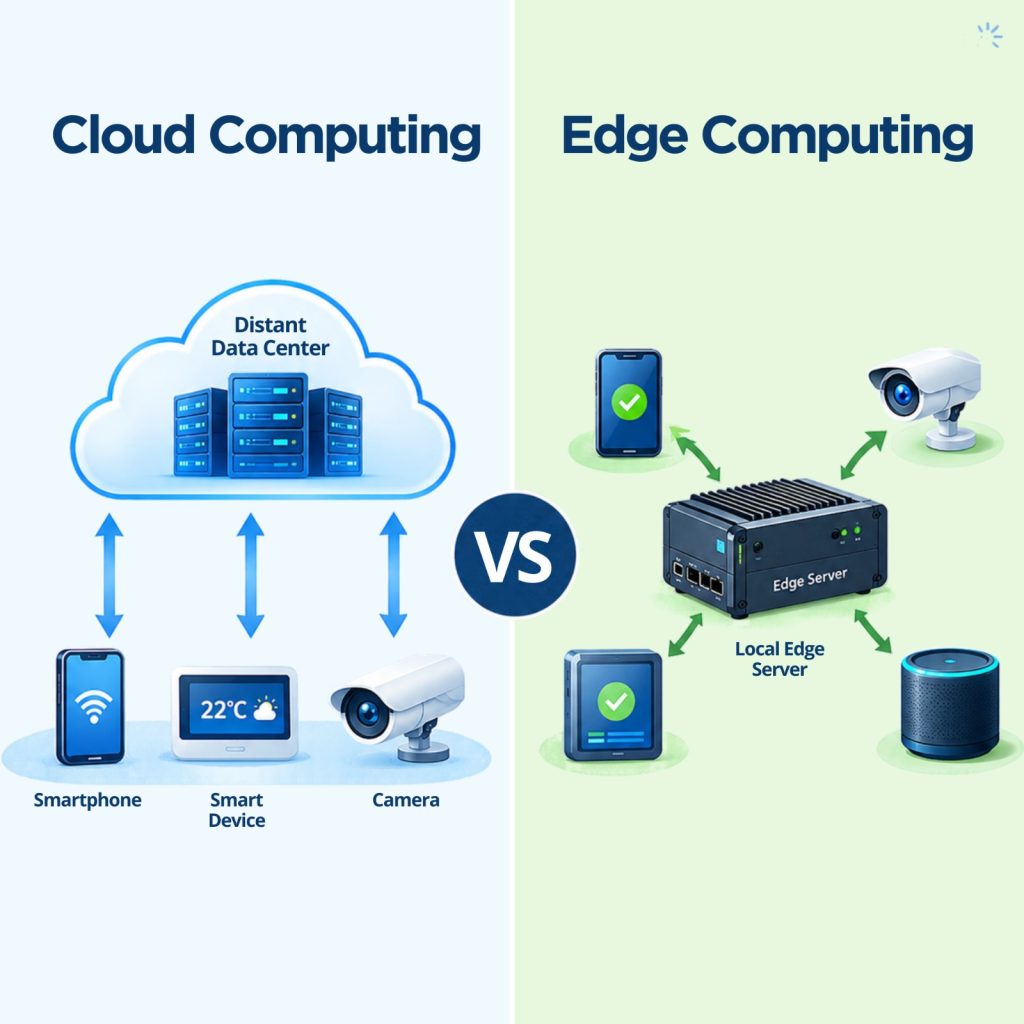
Edge AI processes data directly on local devices or nearby systems, while Cloud AI uses remote servers. This affects processing speed, internet dependency, data privacy, and computing resources. Edge AI is ideal for applications requiring quick responses and local processing. Cloud AI is better suited for handling large datasets, complex computations, and centralized data management. Edge AI can reduce network delays by processing information closer to its source.
Edge AI
Processing: Analyzes data locally on devices or nearby systems. |
Response Time: Often provides faster responses for local tasks. |
Connectivity: Supports offline operation for compatible tasks. |
Data Privacy: Can keep sensitive data on the device. |
Computing Resources: Limited by local hardware capabilities. |
Best Use Cases: Real-time monitoring, connected devices, and immediate decisions. |
Cloud AI
Processing: Analyzes data using remote cloud servers. |
Response Time: Depends on network latency and server response. |
Connectivity: Usually requires an internet connection for processing. |
Data Privacy: May involve transferring data to remote servers. |
Computing Resources: Offers scalable computing power. |
Best Use Cases: Suitable for large-scale data processing, complex computations, and centralized analytics. |
Neither approach is universally better. Many businesses combine both technologies to balance speed, cost, privacy, and computing capacity. For example, a smart camera may detect events locally using Edge AI while sending selected footage to the cloud for long-term storage and further analysis
Challenges of Edge AI
Despite its advantages, Edge AI introduces several technical and operational challenges that businesses must consider before implementation.
- Limited Hardware: Edge devices may not have enough memory or processing power to run complex AI models efficiently.
- Model Optimization: AI models often require compression, quantization, or other optimization techniques to operate effectively on local hardware.
- Device Management: Deploying updates, monitoring performance, and maintaining software across multiple devices can be complicated.
- Security Risks: Physical devices may be vulnerable to tampering, unauthorized access, and software vulnerabilities.
- Scalability: Expanding Edge AI across hundreds or thousands of devices requires effective deployment, monitoring, and maintenance strategies.
- Maintenance Requirements: Businesses need to manage model versions, hardware compatibility, and ongoing system updates to maintain reliable performance.
Conclusion
Edge AI is changing how businesses design and deploy systems by moving AI processing nearer to where data’s generated. Faster responses, better data control, bandwidth usage and support for operations make Edge AI an increasingly valuable option for many applications. However cloud computing stays important for workloads that need processing power and centralized infrastructure. Edge AI also brings challenges such as hardware limits, security, model optimisation and device management. The best approach usually blends Edge AI with cloud services letting each technology perform the tasks it does best. For businesses exploring AI applications, grasping this balance can help them build systems that’re more responsive, efficient and adaptable, to future technological demands.